If you’ve ever taught Spanish in a classroom, you’ve probably had one of those moments when a student looks at you and says, “I know this word… but I can’t remember what it means!”
And we’ve been there too.
Because we know learning vocabulary can be challenging for Spanish learners.
They may recognize a word one day, then forget it the next.
Or, they may know what a word means when they see it on a vocabulary list, but struggle to understand it when they encounter it in a sentence or use it in a conversation.
As teachers, we know that simply giving students a list of words to memorize doesn’t lead to lasting learning.
So, how can we make vocabulary practice more meaningful?
For us, one of the best ways is to give students opportunities to see, hear, use, and revisit new words in different contexts.
Instead of treating vocabulary as a separate part of the Spanish lesson, we can weave it into activities that students are already doing: reading a story, answering questions, talking with a friend, or completing a classroom challenge/game.
In this post, we’re sharing three of our favorite ways to help Spanish learners build vocabulary in the classroom: Reading Comprehension Passages, Poems, and Task Cards.
Each strategy gives students opportunities to encounter new words while also developing other important language skills, including reading comprehension, listening, speaking, and critical thinking.
Let’s take a look!
But first:
Why Is Building Spanish Vocabulary So Important?
Vocabulary is one of the building blocks of language learning.
Students can know how to form a sentence grammatically, but if they don’t know the words they need, communicating that idea becomes much harder.
So, the more vocabulary they understand, the more they can do with the language.
They can:
- understand what they read
- follow what they hear
- participate in conversations
- express their own ideas.
And there’s something else we’ve noticed, which is: students need to encounter words again and again.
Learning árbol once for example, doesn’t necessarily mean a student will remember it next week. But if students see árbol in a book, hear it in a song, use it in a conversation, and encounter it again in a flashcard, the word starts to become more familiar.
So… How Can They Actually Practice Vocabulary?
The key is giving students opportunities to meet the same words more than once, and use them in meaningful contexts.
It doesn’t always need its own separate worksheet or memorization activity.
Sometimes, the best vocabulary practice doesn’t look like vocabulary practice at all.
When words are connected to something they enjoy reading, hearing, discussing, or thinking about, they become much more meaningful.
The more opportunities students have to interact with language, the more natural and memorable it can become. That’s why we love activities that allow vocabulary to naturally come back into the lesson.
Here are three strategies we love using with Spanish learners.
- READING COMPREHENSION PASSAGES
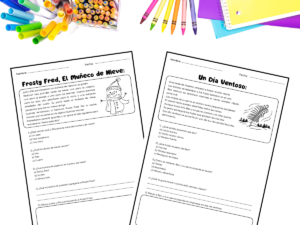
Reading is one of our favorite ways to introduce and reinforce Spanish vocabulary.
When students read a passage, they’re not just learning individual words. They’re seeing those words in context, surrounded by other words and ideas that can help them understand their meaning.
For younger learners, short and engaging passages can introduce vocabulary related to familiar topics such as family, school, animals, food, nature, hobbies, or everyday life.
We can introduce theme-related words through a story or informational passage, so kids have a reason to use those words.
They can see how they work in a sentence and how they connect to the rest of the text.
Reading helps students figure out new words:
One thing we really want our students to learn is that they don’t have to know every single word in order to understand a Spanish text.
This is why this is a great opportunity to teach them how to use context clues.
For example, you might stop during a reading activity and ask:
“What do you think this word means? or
What clues in the sentence helped you?”
Instead of immediately translating the word for them, they have to look at the information around it and make a reasonable guess.
That’s a skill they can take with them to future Spanish texts.
Reading develops more than vocabulary:
This is another reason why we love using reading comprehension activities for vocabulary practice. Students are working on several skills at the same time, such as reading comprehension, critical thinking, language awareness and context clues, apart from vocabulary.
For our younger Spanish learners, we created Spanish reading comprehension resources for 1st–3rd grade that combine engaging texts with comprehension activities. You can check them out here.
- SHORT POEMS
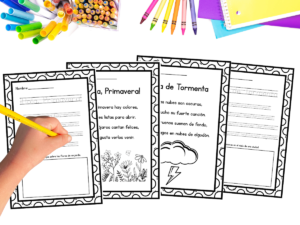
We love this one, especially with younger learners.
There’s something about rhythm, repetition, and a short, memorable text that can make new vocabulary stick for them.
A poem about the seasons, for example, might introduce words such as:
sol, lluvia, flores, viento, hojas, frío, y calor.
Instead of learning those words from a list, students encounter them as part of a larger piece of language.
And that’s where poetry becomes really useful.
Repetition helps vocabulary stick:
Vocabulary needs repetition, and poems naturally provide it.
Every time students encounter the vocabulary again, they’re strengthening that connection.
Poems support listening and speaking too:
Another thing we love about poetry is that it doesn’t have to stay on the page.
When kids listen to a poem being read aloud, they’re practicing listening comprehension while hearing Spanish pronunciation, rhythm, and intonation.
When they read the poem aloud, they’re practicing pronunciation and speaking.
And when they discuss what the poem means or explain what they noticed, they’re communicating in Spanish.
For our 1st–3rd grade Spanish learners, we created poetry resources that combine short, engaging poems with activities that help students interact with vocabulary and meaning. Have a look here.
They can be used as a quick language activity, a reading center, morning work, or simply as a fun way to bring some variety into a Spanish lesson.
- TASK CARDS
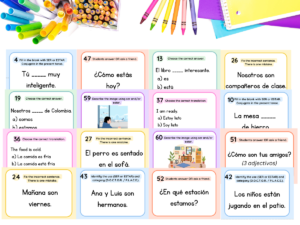
As kids get older, vocabulary practice starts to look a little different.
Students in grades 5–12 are ready for activities that encourage them to do more than recognize a word.
Understand it, yes, but mostly use it.
And how can they do that?
Well, this is why we love using task cards.
Each card can present a different question or situation where students get multiple opportunities to interact with vocabulary.
From recognizing a word to actually using it:
They might be asked to
- Complete a sentence with the correct Spanish word.
- Choose the word that best fits a context.
- Explain an idea.
- Determine the meaning of a word from context.
- Discuss an answer with a partner.
And that active practice helps them make vocabulary more useful and memorable.
Task cards can turn vocabulary into communication:
We also love using task cards because they can easily become speaking activities.
For example, students can read a card independently, think about their answer, and then explain it to a partner.
Suddenly, a vocabulary activity has become a speaking opportunity.
Students are practicing vocabulary while also learning how to communicate an idea, explain their thinking, and listen to another person’s response.
For older Spanish learners, we created Spanish task cards for grades 5–12 with this kind of flexible practice in mind.
They’re designed to give students opportunities to interact with Spanish vocabulary while also practicing comprehension, communication, and critical thinking.
IMPROVE VOCABULARY THROUGH MEANINGFUL PRACTICE
No matter which strategy you choose, there’s one thing we know for sure, and that is that students need meaningful opportunities to encounter and use vocabulary repeatedly.
That repetition across different activities can help students gradually move vocabulary from something they simply recognize to something they can actually use.
From New Words to Real Language
At the end of the day, improving Spanish vocabulary isn’t just about knowing more words. It’s about giving students the language they need to understand, communicate, and think.
And these three strategies we shared with you are about that.
A reading passage can introduce a new word and help students discover its meaning from context.
A poem can make that same word more memorable through repetition, rhythm, and imagery.
And a task card can give students another opportunity to retrieve the word, apply it, and perhaps even use it in a conversation.
This is why we love combining vocabulary practice with other language skills.
We hope these ideas give you a few new ways to bring vocabulary into your Spanish classroom—and make learning new words feel more meaningful and memorable for your students!
See you next time!